Background
For my thesis, what I want to do is to solve the problems that teens face with their emotions and mental health, and they might not get proper help from their surroundings. The reason why I would like to focus on this topic is from my personal experience. When I was a teen, I was depressed often because of family issues, and I did not get proper help from my surroundings. Growing up, I found that that period was painful, leaving some issues for me, especially for mental. I hope that I can provide some help or guidance for teens who might also go through the same experiences as me via my design.
According to data from the National Institute of Mental Health (NIMH) in the United States, in 2020, approximately 21% of adolescents (ages 12-17) experienced at least one major depressive episode in the past year. Additionally, the Anxiety and Depression Association of America (ADAA) reported that anxiety disorders are the most common mental health disorders among adolescents, affecting about 25% of them. Solving such mental illness is not an easy thing and involves multiple support systems. However, according to Jai K. Das, focusing on mental health promotion that enhances mental well-being proves more effective than simply trying to prevent mental illness in enhancing adolescent mental health (Jai K. Das M.D. et al., 2016). A key component of this approach involves addressing and resolving emotional distress. Emotional distress, particularly when intense and chronic, can lead to mental health issues like depression and anxiety if not properly managed. In other words, by managing emotional distress effectively, the risk of developing more severe mental health issues can be reduced. Therefore, finding ways to help teens navigate and overcome their emotional distress is a crucial step in preventing the escalation of these mental health conditions.
Design Process(ADDIE model)
Analysis
I conducted Primary Research(a survey with 50 responses and interviews with 6 teens) and Secondary Research to know my target users and the challenges they are facing.
Research Synthesis:
01
Prevalence and Nature of Emotional Distress
Teenagers frequently experience emotional distress, with academic stress being the most common cause, followed by issues related to social connections, life issues, existing mental health problems, and physical changes.
02
Lack of Adequate Support
Most teens feel that they do not receive sufficient care and support when experiencing emotional distress. The support they do receive often fails to address their issues because caregivers may not understand their emotional needs, and lack the time, or the skills to provide effective help.
03
Barriers to Effective Resolution of Emotional Distress
-
Teens are hesitant to actively seek help, often due to vulnerability, sensitivity, and a preference for peer support over professional assistance.
-
Privacy concerns, lack of awareness, cultural perceptions, and the inaccessibility of mental health resources further complicate teens' ability to seek and receive help.
Learner Analysis
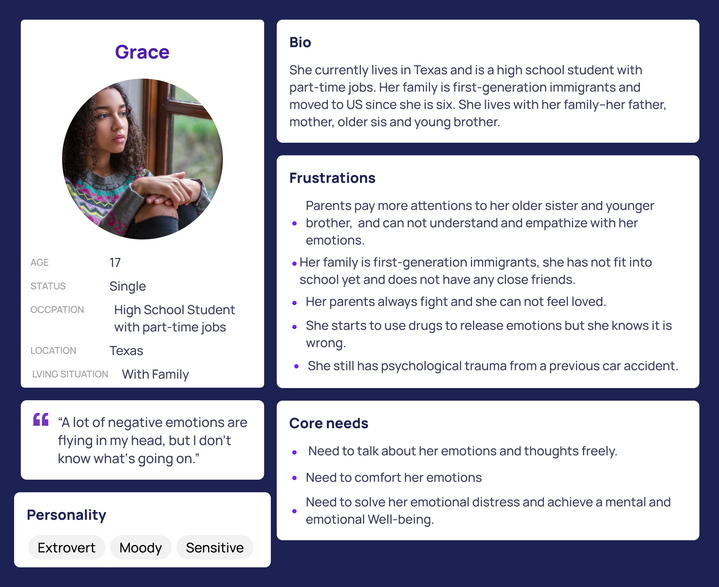
According to my research, the typical learner characteristics would be:
-
Teens (age 13-18) from China including those living in other countries who struggle with emotional distress.
-
Facing barriers to solving their emotional distress and getting help from their surroundings.
-
Lack of awareness and correct cognition about mental health.
-
Having access to smartphones, social media, and digital platforms.
Persona#1

Persona#2
Problem Statement
Teens who struggle with emotional distress need proper support to get out of a bad mood, solve their emotional discomfort, and improve their adolescent experience, considering the barriers that they can not get help from their surroundings and lack of correct cognition about mental health.
HMW
01
How might we engage teens and increase their motivation to deal with their emotional distress (and learn the knowledge they should know)?
03
How might we help teens to be aware of their mental status and improve their cognition about this field?
02
How might we give teens support when they struggle with emotional distress and lack access to caring support and resources?
04
How might we let teens feel accompanied, empathetic, and comforting?
Learning Goal
Teens will identify factors impacting their mental health, including recognizing and transforming negative thoughts.
Teens will understand when and how to seek help effectively when experiencing emotional distress.
Teens will acquire comprehensive knowledge about mental health and other pertinent topics.
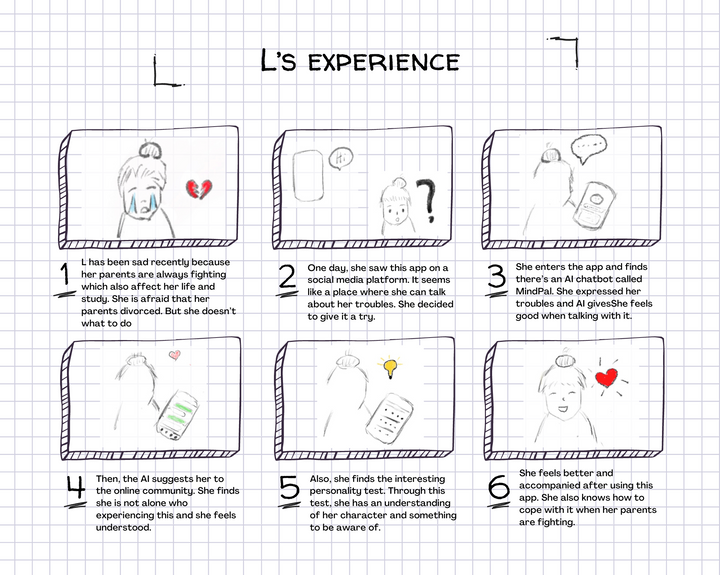
Storyboard
Design Solutions
AI Chatbot
-
Judgment-free zone
-
Foster a more positive mindset
-
Coping methods


Why AI?
According to HealthLine, “Healing often doesn’t happen in isolation, and many people need a sense of connection and community to begin moving forward” (Clements, 2022). Emotional distress necessitates seeking help, whether from a therapist or a supportive network. However, many of my target users face barriers such as limited access to therapists and a lack of proper support. This is where psychological artificial intelligence (AI) can bridge the gap.
While AI cannot replace the authentic empathy and understanding that a human therapist provides (Boyles, 2024), it offers notable advantages in convenience and support. AI chatbots can provide reassurance and guidance when no other support is available (Aggarwall, n.d.). A study in the Proceedings of the National Academy of Sciences (PNAS) found that AI-generated messages can increase hope and reduce stress, illustrating their potential therapeutic impact (Yin, Jia, & Wakslak, 2024).
An interesting experiment compared responses from physicians and AI chatbots to patient questions on a social media forum. Experts rated the AI responses higher for empathy and quality, while physician responses were shorter and less detailed (Ayers, 2023).
In light of these findings, I advocate for the use of AI chatbots in mental health care, especially for teens who might not have easy access to traditional resources. AI can provide a judgment-free space for them to voice their worries, alter negative thought patterns, and develop coping mechanisms, effectively managing some aspects of emotional distress.
Mood Tracker and Journaling
-
Improve emotional regulation.
-
(University of Rochester, n.d.)
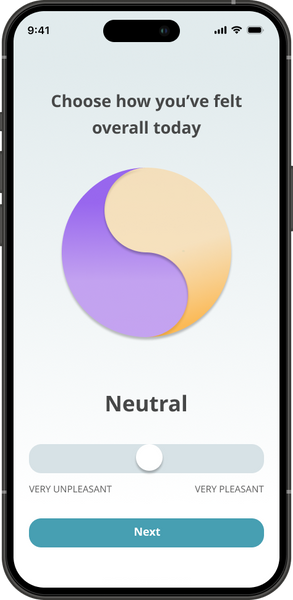

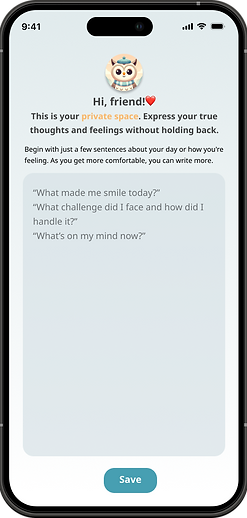
Mood tracking and journaling are powerful tools for mental health. Research by the University of Rochester Medical Center and Schueller and Parks (2012) shows that regular mood check-ins and journaling help individuals manage mental health by prioritizing problems, recognizing triggers, and promoting positive self-talk.
Inspired by the intuitive design of the Apple Health app, my interface features a user-friendly slider bar for easy mood recording. To address the potential shame of expressing negative emotions, I use calm colors and shapes to represent all emotional states, ensuring a supportive environment for users. This design encourages reflection on positive moments, aiding overall well-being.
Tree Hole (Online Community)
-
Connect with peers who facing similar challenges
-
Exchange emotional support and coping strategies
-
Therapists Moderated

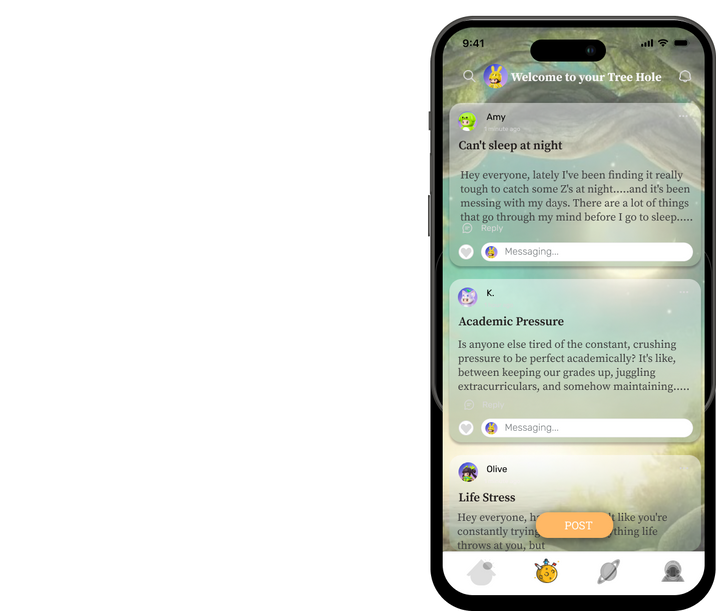
The online community will be the second main feature of this app, it aims to encourage teens to connect with others who share similar experiences and challenges and provide valuable support to each other, which can reduce their loneliness and isolation. Being a part of a supportive community, teens can offer and gain emotional support, valuable information, and coping strategies. Meanwhile, considering the vulnerability and safety of teens, there are two mechanisms in this community to ensure that.
-
Strict Artificial Intelligence Back-End Monitoring System
Users can easily report inappropriate content such as posts promoting self-harm or bullying to the back-end monitoring system, then the posts will be blocked or deleted. Simultaneously, the system actively scans with content filters and removes sensitive words, preventing such messages from being posted. Moreover, when the AI identifies users who send inappropriate content, therapists are notified. They then discreetly contact these users to assess their mental health and determine if there is a need to inform their guardians.
2. Professional Oversight
To positively guide the community’s development, maintain quality, and prevent the Echo Charmer Effect that reinforces their negative behavior and beliefs(Open AI, 2023), real therapists will be involved in this community as moderators. The moderators will use the same series of avatars as users but with unique clothes or decorations, actively participating in the discussion, and providing insights and guidance in a manner that subtly supports without making users feel overly monitored.
Knowledge Exploration
-
Other essential knowledge for adolescents besides mental health
-
Includes videos, images with text, and interactive tests. (Mayer, 1997)

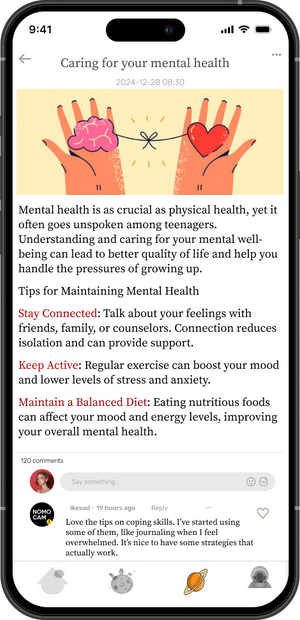
Knowledge exploration is the last main feature of this App. It will encompass video, image with text, and test those 3 main formats that aim to foster users’ learning in an engaging way. The content will include not only mental health but also other resources that are essential for teens, such as Sex Education, Major and Career Exploration, Physical Health, and other topics that they are interested in. To foster learning, users are encouraged to make comments and join conversations under each feed by receiving rewards to increase their motivation.
Media&
Technology Choices
The design will be based on a mobile application with easy affordance which requires a smartphone and access to the Internet. The reason why I chose this media is because of the habit of my target users that they are used to using smartphones every day and the need to easily access the product whenever they want with less effort.
Media Format
According to Mayers’ multimedia learning theory, learners can learn deeply with multimedia presentations, such as images, audio, animation, etc (Richard E. Mayer et al., 2004). In the design of Knowledge Exploration, the content will be presented through multiple modalities to foster learning.
Based on the Mayers’ signaling principle, humans learn best when they are shown exactly what to pay attention to on the screen. Thus, the important content will be highlighted in the article or below the video in different colors or fonts to enhance understanding and retention.

Ethical & Security Consideration
Users are anonymous in this App, and the app will be committed to protecting users’ privacy and data if this app could be further developed in the future. MindPal will be moderated by the professional development team that will take the highest standard to protect and store necessary data. Additionally, we will provide users and their guardians with comprehensive information about the types of data collected, the purposes of collection, and how it is used. With the help of our app's simply accessible privacy settings, users may efficiently manage their personal data and privacy preferences.
Test & Evaluation
Concept Testing
Goal:
-
Assess teens' interest in using AI for emotional distress.
-
Evaluate engagement in the online community.
-
Gauge interest in Knowledge Exploration.
-
Collect improvement suggestions.
Participants:
4 Chinese high school students.
Key Findings:
-
AI Chatbot: Teens are open to AI as a gap-filler between friends and family. Suggested adding interactive elements like chatbot movements, music, and emojis.
-
Online Community: Teens liked the idea but stressed the need for engaging topics and interactive elements.
-
Knowledge Exploration: Interest in active engagement, such as commenting and discussions.
-
Privacy and Safety: Concerns about inappropriate language and data privacy.
Usability Testing
Goal:
-
Evaluate impressions of the hi-fi prototype.
-
Assess user flow in AI chatbot, online community, and knowledge exploration.
-
Gather feedback on aesthetic elements.
Participants:
3 Chinese high school students.
Key Insights:
-
Emotional Connection: Users found the app too rational. Suggested adding voice tones and memes for emotional interactions.
-
Community Interface: Recommendations to enhance the interface to create a "tree hole" (safe, warm space) environment.
-
Guidelines: Need for clear community guidelines and trigger warnings.
Logic Model

Future
Direction
Looking ahead, there is significant room for improvement in the app, such as ensuring compliance with legal requirements for parental consent, enhancing the regulation and training of AI, and adding a miro-learning course that helps teenagers understand how to better use AI including its weaknesses and strengths. Additionally, several ambitious AI features, like human-like voice capabilities and the ability to send emojis or memos, are still under development. Given the rapid pace of AI development, it's challenging to make definitive statements about these uncertainties at this stage. However, as AI technology continues to evolve, it's expected that these issues will be addressed more effectively in the future.
POSTER
